


Greece’s startup renaissance is the result of a strategic, long-term transformation. In 2017, the ecosystem was valued at €1.1 billion. By 2024, that figure had multiplied nearly eightfold to €8.2 billion, driven by a new wave of founders, capital inflows, and a regulatory framework designed to foster innovation.
Once seen as a fragmented, underfunded market, Greece is now a magnet for global investors, with high-growth ventures scaling faster than ever. With 8,100+ startups, the country has already produced two unicorns, with Blueground joining the billiondollar ranks in March 2024. Yet, the real story isn’t just about a handful of high-flying companies— it’s the sheer volume of entrepreneurial activity. In 2024 alone, 63,000 new businesses were registered, marking an 11% year-over-year increase and reinforcing Greece’s status as a fast-growing innovation hub (General Commercial Register and the Union of Hellenic Chambers, 2025).
How did Greece achieve this acceleration? What challenges did founders navigate, and what lessons can the next wave of unicorns take from this growth? This article dissects the structural shifts, investment trends, and market dynamics driving Greece’s startup success—and what it means for the future.
Greece’s Unicorns: The Big Players
Greece has firmly established itself as a serious player in the European startup ecosystem, with two unicorns proving the tremendous potential of the Hellenic business landscape. Both these companies have capitalized on strong international demand, strategic acquisitions, and scalable technology, propelling them to billion-dollar valuations.
Viva Wallet (Fintech) – Greece’s First Unicorn
From €1.1B in 2017 to €8.2B in 2024—Greece’s startup ecosystem has skyrocketed, producing unicorns and attracting global investors at record speed.
Viva Wallet, Greece’s first unicorn, is a cloudbased neobank and payments platform designed for small and medium-sized enterprises (SMEs). Founded in 2000 by Haris Karonis, the company was built to modernize digital transactions, offering businesses a streamlined way to process payments, manage expenses, and access financial tools. After introducing cashless payment adoption in Greece at a time when digital transactions were still gaining traction, Viva Wallet positioned itself well ahead of the curve of other companies. Step by step, the company’s growth accelerated through strategic international expansion, now operating in 24 European markets. Its infrastructure supports multiple payment solutions, including tap-to-device technology, virtual debit card issuance, and merchant cash advances, making it a comprehensive financial ecosystem for businesses. Viva Wallet’s seamless integration with Visa, Mastercard, and Apple Pay reinforced its credibility and reach, ensuring widespread adoption across diverse markets.
In 2022, JP Morgan acquired a 49% stake, valuing the company at over $1 billion and solidifying its place in the global fintech landscape (JP Morgan, 2022). The investment provided the capital and resources needed to scale further, allowing Viva Wallet to compete with major European payment platforms. With its advanced cloud infrastructure and merchant-focused services, Viva Wallet continues to expand across Europe, bridging the gap between traditional banking and modern financial solutions.
PeopleCert (EdTech) – A Global Certification Powerhouse
PeopleCert, founded in 2000 by Byron Nicolaides, is a global professional certification exam leader specializing in IT, project management, and language proficiency. Unlike many high-growth startups, PeopleCert scaled without external funding, reaching a valuation of over $1 billion purely through organic growth and strategic acquisitions.
The company transformed professional certification by developing a technology-driven assessment platform used by governments, multinational corporations, and academic institutions. Its ability to deliver standardized, globally recognized qualifications positioned it as an essential player in the workforce upskilling industry. The demand for IT certifications, particularly ITIL and PRINCE2, has skyrocketed in recent years as businesses increasingly prioritize digital transformation and project management expertise.
A defining moment for PeopleCert was its 2021 acquisition of Axelos, the UK-based organization behind ITIL and PRINCE2, making it the world’s largest IT certification provider (PeopleCert, 2021). This acquisition expanded PeopleCert’s market share and strengthened its presence in 160+ countries, now delivering over 7 million exams annually. The company’s growth has been fueled by the shift toward online education and the global demand for professional credentials, which became even more critical in the post-pandemic digital economy.
Swift and diverse, PeopleCert’s model allows organizations worldwide to access standardized skill validation. The company mainly scaled without venture capital, a dynamic that sets it apart in the startup world, proving that sustainable, high-growth businesses can emerge outside the traditional funding model.
What Made These Unicorns Successful?
Greece’s unicorns didn’t appear overnight. Their rise is the result of a decade of smart funding strategies, global ambition, and a well-connected talent pool. The country has built a startup ecosystem that can compete beyond its borders, fueled by government-backed capital, research-driven innovation, and an expanding venture landscape. Here’s how they did it.
1. Funding Ecosystem That Works
Access to capital is the lifeblood of any startup ecosystem, and Greece has spent years laying the foundation. EquiFund and JEREMIE were among the first large-scale initiatives to inject real money into early-stage Greek startups, paving the way for bigger venture rounds and international exits. This structured investment approach is now paying off. In 2023 alone, over 70 Greek startups raised more than €485 million, with a third of them having previously received EquiFund backing. Beyond VC money, Greece has leveraged EU grants, government incentives, and startup-friendly tax policies to lower barriers for founders. Startups like Viva Wallet, PeopleCert, and Hellas Direct all tapped into these funding channels to scale.
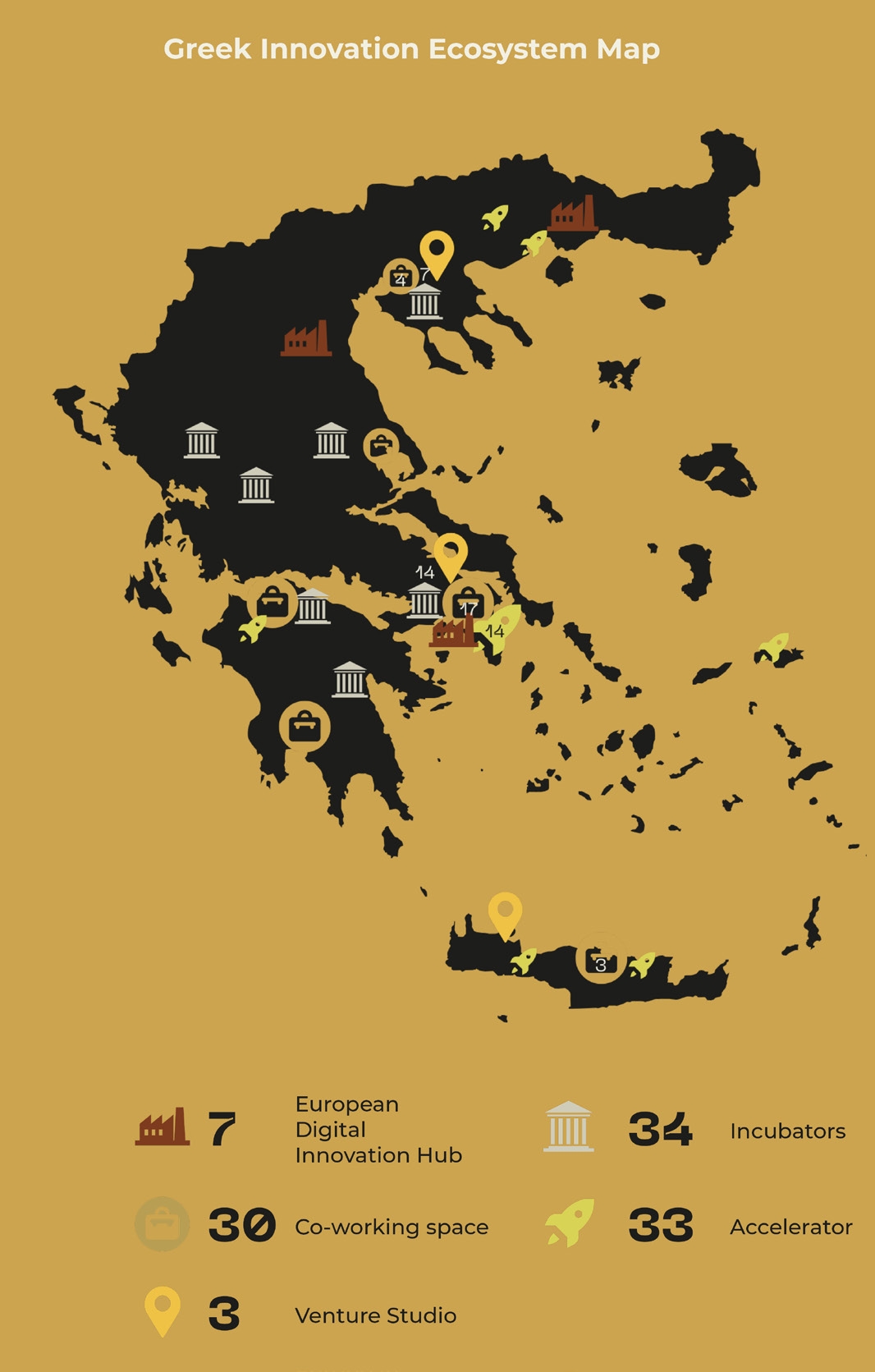
2. Science Parks & Research Hubs Fuel Deep-Tech Startups
Startups need an innovation infrastructure—one that connects research, talent, and industry. Greece has built exactly that through its technology parks and incubators, which help startups move from R&D to real-world applications. Lefkippos Tech Park and the Thessaloniki Innovation & Technology Center are two of the most important players in this space. They offer startups access to academic collaborations, accelerator programs, and lab facilities, making them especially valuable for deep-tech, biotech, and AI-driven companies. These hubs have helped bridge the gap between university research and venture-backed innovation, a model that has worked well in markets like Israel and Germany.
3. Global Ambition from Day One
Innovative Greek companies didn’t limit themselves to their home market. They designed their businesses for international scalability from the start. As a domino effect, this bold approach allowed them to grow faster, raise bigger rounds, and attract top-tier investors. Viva Wallet, Blueground, and Workable all expanded to highvalue markets like the US, UK, and Germany early, ensuring they weren’t dependent on Greece’s smaller customer base.
4. The Greek Diaspora as a Growth Engine
Greece has something many countries don’t: a powerful global network of expat entrepreneurs, investors, and engineers. This has become one of its biggest startup advantages. Greek founders based abroad have built startups worth $100 billion—10 times the value of those headquartered in Greece (EU Startups, 2023). Many entrepreneurs are reinvesting in the Greek ecosystem, helping local startups expand faster. Besides, Greek AI researchers and engineers have a strong presence at top conferences like NeurIPS and ICML and work at leading tech firms worldwide (Recursive, 2023). Some are now coming back to Greece to build world-class companies, leveraging their networks to bridge local startups with Silicon Valley, London, and Berlin.
5. Fixing What’s Broken: Industry-Specific Innovation
Successful startups don’t just chase trends—they solve real pain points in industries that need modernization. Greece’s unicorns followed this formula, targeting sectors with outdated systems and inefficient processes:
- Viva Wallet modernized payments for small businesses across Europe.
- PeopleCert made professional certification more accessible and scalable.
In short, These companies didn’t invent entirely new industries—they made existing ones better, faster, and more efficient. That’s why they scaled so well.
6. Venture Capital & Private Equity: A Market Finally Taking Off
Greece’s venture capital scene has evolved fast. Just six years ago, most Greek startups had to raise from international investors. Now, the country has a more structured VC and private equity landscape, making it easier for local startups to secure earlystage and growth funding. Since 2017, VC activity in Greece has doubled, with funds like Marathon VC, VentureFriends, and BigPi Ventures leading rounds in fintech, SaaS, and deep-tech companies. Meanwhile, private equity firms are stepping in to back later-stage scale-ups, filling a gap that previously forced many Greek startups to seek capital abroad.
7. A Business Climate That’s Actually Improving
It wasn’t long ago that Greece was considered a challenging place to scale a business. But in the past few years, the business climate has shifted in favor of startups and investors. Greece’s postCOVID recovery plan, combined with reforms in banking, tax policy, and corporate governance, has led to stronger employment growth and increased foreign direct investment (FDI). EY’s Attractiveness Survey Greece found that 58% of investors say the country has become a more appealing investment destination, and 75% expect conditions to improve further over the next three years (EY, 2024).
The Next Wave: Who Will Be Greece’s Next Unicorns?
A new wave of Greek startups is making waves in AI, cloud computing, and disruptive business models, expanding across Europe, the Middle East, and the US.
Spotawheel: AI-Powered Used Car Marketplace
Europe’s €725 billion used car market is plagued by pricing mismatches and trust issues (GMI, 2025). Spotawheel tackles this with AI-driven inspections, dynamic pricing, and digital transactions, making car buying more transparent. Founded in 2016, the company rapidly expanded into CEE and Germany, riding the shift toward online car sales.
FlexCar: The Subscription-Based Future of Car Ownership
FlexCar brings a fresh approach to car leasing with flexible, subscription-based ownership, eliminating upfront costs and long-term commitments. Launched in 2018, it’s already scaling across Europe and the Middle East, tapping into a multi-billiondollar mobility market as consumers shift toward pay-as-you-go models.
TileDB: Reshaping Big Data Management
Data is complex, scattered, and growing fast. TileDB solves this with a cloud-native, universal storage engine, helping scientists, AI developers, and financial analysts manage vast datasets more efficiently. Backed by Intel Capital and Nexus Venture Partners, TileDB is emerging as a strong alternative to PostgreSQL and Snowflake.
Better Origin: AI-Driven Food Waste to Sustainable Protein
Food waste is a $1 trillion problem, and Better Origin is turning it into high-protein animal feed using AI-powered insect farming (UNFCCC, 2024). Already scaling across EU markets, the company is at the forefront of circular economy solutions, helping food producers reduce waste and improve sustainability.
Hack The Box: Gamified Cybersecurity Training
With cybercrime damages projected to reach $20 trillion by 2026, companies are racing to train security experts (Evolve Security, 2024). Hack The Box has built one of the fastest-growing ethical hacking platforms, offering real-world penetration testing environments. Founded in 2017, it works with major enterprises and defense organizations worldwide.
Challenges Greek Startups Face on the Path to Unicorn Status
Notwithstanding the great opportunities presented by Greece, founders must be prepared to navigate complex international landscapes while solving internal inefficiencies
1. Scaling Beyond Greece
The domestic market’s limited size compels Greek startups to pursue international expansion early in their development. Although this strategy offers access to larger markets, it also presents challenges such as navigating diverse regulatory environments and understanding varied consumer behaviors.
2. Talent Retention
Greece boasts a highly educated workforce, particularly in the science and technology sectors. But, many skilled professionals seek opportunities abroad, leading to a domestic talent drain. This trend poses recruitment challenges for scaling startups as they struggle to attract and retain the expertise needed for growth. The high unemployment rates paradoxically coexist with this talent exodus, underscoring the complexity of the issue.
3. Bureaucracy and Regulation
A NY Times title published in February 2025 sums up pretty well one of the most pressing problems faced by the country: “Greek Bureaucracy, Not Just Austerity, Is an Economic Drag.” Despite governmental efforts to streamline processes, bureaucratic hurdles and regulatory complexities continue to impede startup growth. These challenges can deter both domestic and international entrepreneurs, making it imperative for ongoing reforms to focus on reducing red tape and fostering a more business-friendly environment.
Conclusion: The Future of Greek Unicorns Without a doubt, Greece has moved beyond the stage of proving itself—it is now an emerging force in global tech. With unicorns scaling internationally, venture capital inflows rising, and government-backed incentives aligning with innovation, the ecosystem has reached a point where Greek startups are no longer the underdog—they are serious contenders in high-growth sectors.
Unlike past cycles of fragmented growth, this time, the ecosystem has the capital, talent, and international networks to sustain its trajectory. For investors, Greece presents a unique opportunity—a maturing ecosystem with less saturation and higher upside than traditional European tech hubs.