
Medicine has always been a game of time— how fast a disease is detected, how accurately it is diagnosed, and how quickly a treatment is developed. Now, AI is doing what once seemed impossible: shrinking drug discovery timelines, reducing misdiagnoses, and making medicine more precise than ever. Its tremendous ability to process and compare millions of cases in real time introduces an extra layer of scrutiny, reducing human oversight and increasing diagnostic confidence. It brings speed, precision, and new possibilities to a field where accuracy can mean the difference between life and death.
Now, AI is doing what once seemed impossible: shrinking drug discovery timelines, reducing misdiagnoses, and making medicine more precise than ever.
AI’s intersection with biotech is creating one of the biggest investment opportunities in history. Startups are raising billions, Big Pharma is embedding AI into its R&D pipelines, and AIpowered diagnostics are becoming standard practice. The healthcare value chain is no longer linear. AI is collapsing the gap between early detection and treatment, transforming healthcare into a predictive, personalized system where every diagnosis sets the stage for precision-tailored intervention.
In this article, we break down the financial currents driving AI in healthcare, spotlighting key players, breakthrough innovations, and the strategic investment opportunities that will pave the industry’s future.
VCs, IPOs, and Pharma Giants: The High-Stakes Partnerships & Investments Transforming Global Healthcare
- AI-driven diagnostics, drug discovery, and automation could cut global healthcare costs between $1.5 and up to $3 trillion by 2030.
- The AI healthcare market is set to explode from $28B (2024) to $491B (2032), a 17x surge.
- AI-powered clinical tools now capture 52% of all AI healthcare investments.
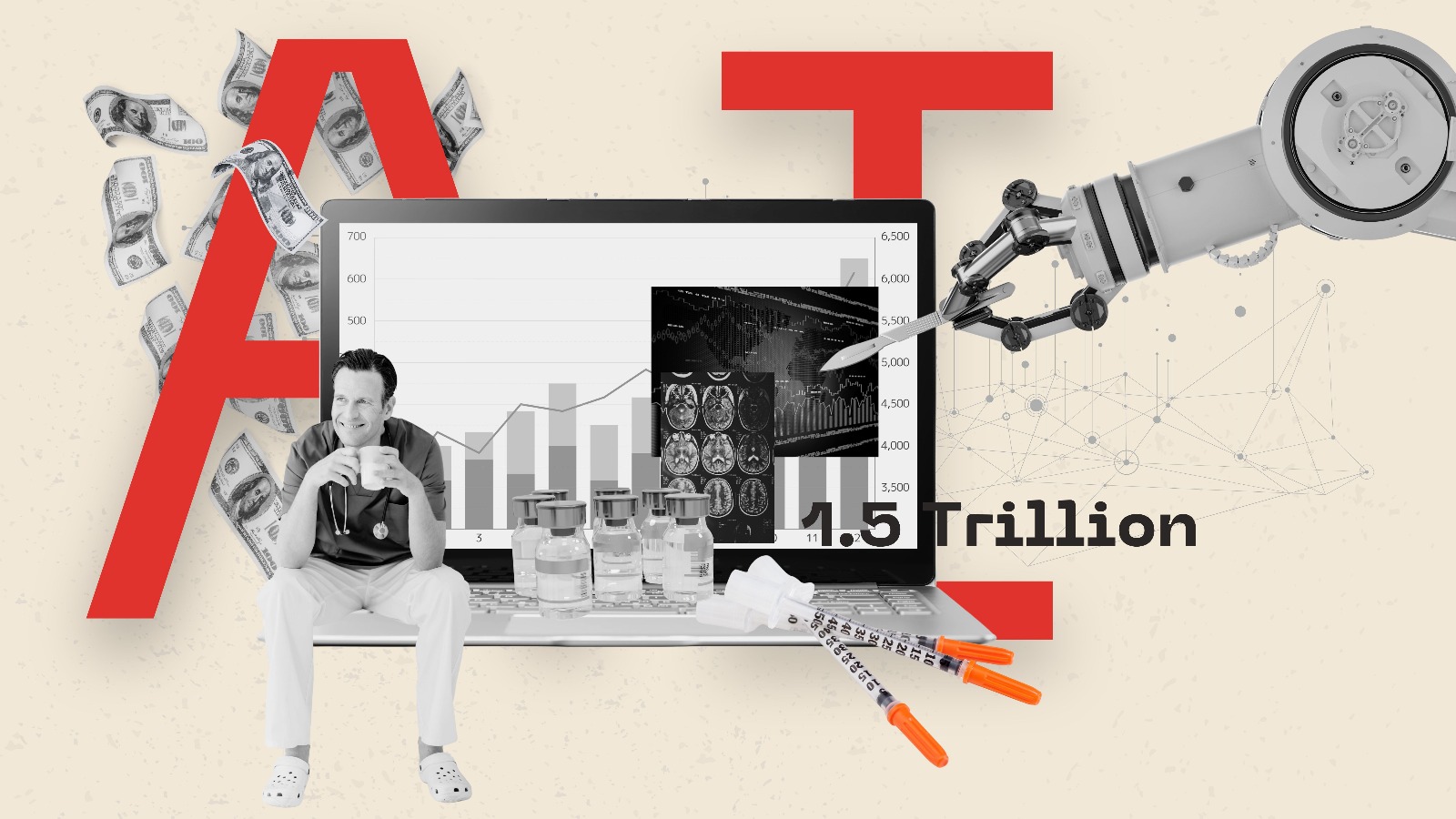
Innovations brought by AI open up vast new opportunities in healthcare, offering smarter, more efficient ways to deliver care. The McKinsey Global Institute estimates that by 2030, AI, remote monitoring, and automation could reduce healthcare expenses by $1.5 trillion to $3 trillion annually. In 2024, the AI healthcare market was valued at approximately $28 billion – by 2032, it’s projected to reach almost $491 billion (Fortune Business Insights, 2024)!
Over the past few years, leading Big Pharma companies have moved beyond isolated AI experiments to fully integrated strategies, often through high-impact partnerships. Early stage drug discovery, where AI’s impact is most pronounced, has been a major focus for Sanofi, which developed the plAI platform with Aily Labs and partnered with Insilico Medicine to enhance molecular targeting. AstraZeneca, which has advanced AI-driven research with Benevolent AI, has expanded into heart failure, chronic kidney disease, and pulmonary fibrosis. Both companies are using AI to refine target identification, reducing uncertainty in the discovery phase.
AI’s influence extends into clinical trials, where Janssen is applying its Trials360.ai platform to over 100 projects, optimizing trial design and execution. Working with Microsoft and NVIDIA, Novartis has been embedding AI across 150 projects, from drug discovery to personalized treatments. Pfizer, leveraging AI’s predictive power, worked with IBM to develop PAXLOVID at unprecedented speed, cutting development time by up to 90%.
Venture capital flows where the next revolution unfolds; in biotech, that revolution is AI. Although global funding trends have cooled, AI-driven healthcare remains a bright spot, attracting billions in fresh capital. In 2024, American healthcare startups secured $23 billion in funding, up from $20 billion in 2023, with nearly 30% directed toward AIfocused companies (Silicon Valley Bank, 2024).
The scale of funding reflects the sector’s tremendous momentum. Abridge, specializing in AI-powered clinical documentation, raised $250 million in a round led by Elad Gil and IVP, scaling its platform already deployed across 100 healthcare systems (Reuters, 2025). Latent Labs, founded by a former DeepMind scientist, secured $50 million from Radical Ventures and Sofinnova Partners to advance AI-driven protein design for drug discovery (The Times, 2025). Justpoint, an AI-powered medical record analysis startup, raised $45 million in Series A financing and a $50 million credit line to identify harmful drugs and chemicals linked to health risks (WSJ, 2025).
Despite an overall slowdown in venture capital, AI-driven healthcare remains an exception. ARCH Venture Partners closed a $3 billion fund in late 2024, focusing on AI-powered biotech and precision medicine, while pharma giants Pfizer, Roche, and Novartis continue forging AI partnerships to cut drug development timelines from years to months (Barrons, 2024).
How AI Sees What Humans Can’t : Why Drug Discovery and Diagnostics Are Fundamentally About Pattern Recognition
- Misdiagnosis affects 11.1% of cases—AI helps by analyzing millions of patient records for subtle disease markers.
- AI-driven models detect patterns in genetic, biochemical, and imaging data, outperforming traditional diagnostics in accuracy and speed.
- Deep learning networks refine themselves, continuously improving disease detection and treatment predictions.
Medicine has always been about pattern recognition. Physicians rely on systematizing patterns, a cognitive process deeply ingrained in human intelligence, to categorize, analyze, and predict disease behavior. Spotting a shadow on a lung scan. Connecting symptoms to a rare disease. Predicting which treatment will work best. Misdiagnosis is still a major issue in healthcare,
affecting both patient outcomes and costs. On average, diagnostic errors happen in 11.1% of cases (Hopkins Institute, 2024).
Much like diagnosis, drug discovery is fundamentally a pattern recognition challenge—a search for molecular structures, biological pathways, and therapeutic targets that align to combat disease. Just as physicians identify symptom patterns to diagnose illness, researchers rely on systematizing molecular interactions, genetic markers, and biochemical responses to predict which compounds will become effective treatments.
Deep learning algorithms mimic how the human brain processes information, using artificial neural networks that consist of multiple layers. Each layer processes data in increasingly abstract
ways, allowing the model to automatically detect patterns and features within raw, unstructured data—such as images, audio, and text—without requiring explicit human intervention in feature design. Now, AI is doing all of this—at a speed and scale no human ever could.
As these networks analyze vast amounts of information, they iteratively refine their internal representations, achieving remarkable accuracy in tasks such as image recognition, language
translation, and voice synthesis. Across over 85,000 cases, doctors selected an AI-suggested diagnosis 84.2% of the time (Zelter et al., 2023). Agreement rates were particularly high for common conditions—for nearly 70% of cases, providers and AI agreed at least 90% of the time. MI GPSai, an advanced AI model trained on 57,489 cases and validated on 19,555, predicts tumor type from 21 cancer categories with 94% accuracy in 93% of cases (Abraham et al., 2024). When considering the top two predictions, accuracy climbs to 97%, making it one of the most effective tools in precision oncology.
The main advantage of deep neural networks is their capacity to detect subtle deviations from the norm. In oncology, AI pinpoints molecular markers that signal aggressive cancers before symptoms emerge. In pharmacology, it predicts how chemical compounds will interact with biological systems, reducing reliance on slow, failure-prone trialand-error methods. AI does not replace scientific intuition—it enhances it, making medical pattern detection more precise, scalable, and predictive.
Models like DeepDTA and WideDTA use text-based representations of molecules and proteins to identify key interactions (Javid et al., 2025). While DeepDTA relies on full-length sequences, WideDTA improves accuracy by breaking them into smaller fragments. PADME takes a different approach, using both molecular fingerprints and graphbased learning to analyze chemical structures in more detail.
Even more, AI enables predictive and personalized medicine by identifying patients at risk before symptoms appear. Deep learning models trained on bone scans have been shown to predict prostate cancer survival rates, helping guide more targeted treatment approaches. In cardiology, AI-driven cardiovascular MRI analysis is being used to assess myocardial strain after heart attacks, improving risk stratification and post-event care. In chronic disease management, AI-driven MRI clustering algorithms optimize home-based monitoring for diabetic nephropathy, improving long-term care strategies and early intervention efforts.
AI in Diagnostics & Drug Discovery – The Race for Early Disease Detection
- AI-powered imaging boosts accuracy, with Lunit AI improving breast cancer detection by 20% and CT scans spotting lung nodules 8.4% better than radiologists.
- Liquid biopsies like Grail’s Galleri detect 50+ cancers from a single blood draw, catching tumors before symptoms appear.
- AI continuously refines its accuracy, providing faster and more precise diagnostics across radiology, pathology, and molecular screening.
Drug development has been a slow, expensive gamble: bringing a new treatment to market takes 10–15 years and can cost billions—only for 90% of candidates to fail in clinical trials. Instead of manually screening molecules in a lab, AI can analyze millions in days, identifying the most promising drug candidates before a human experiment begins. Companies like Exscientia, Insilico Medicine, and BenevolentAI have already developed AI-designed drugs, some of which entered clinical trials in less than 12 months.
The drug discovery market is expected to reach $106.7 billion by 2025 on the backdrop of advancements in AI, automation, and biotech innovation (Mordor Intelligence, 2025). With a projected annual growth rate of 6.6%, the market is set to expand to $146.8 billion by 2030. AI is helping identify the right patients faster, predict which treatments will work best, and reduce trial failures by pinpointing early warning signs of ineffective drugs. Fewer wasted years. Fewer lost billions. A pipeline that moves faster from lab to life-saving treatment.
Algorithms are catching tumors before symptoms emerge, analyzing blood for microscopic disease markers, and accelerating drug discovery at speeds no human researcher can match. AI-driven patient diagnostics now capture 52% of total clinical AI investment, with diagnostic imaging seeing the sharpest growth, having doubled since early 2021 (SVB, 2024).
Unlike traditional diagnostic methods, AI is not limited by memory, fatigue, or subjective bias. It continuously learns from vast datasets of medical images, patient records, and clinical guidelines, adapting its decision-making through ML and deep learning algorithms. This ability to identify anomalies, recognize patterns, and refine accuracy over time makes AI a dynamic and evolving tool in modern medicine. Qure.ai’s AI-driven tuberculosis screening, deployed in over 50 countries, analyzes X-rays in under a minute, making rapid diagnosis possible even in remote clinics. Meanwhile, Lunit AI, now FDA-approved, is revolutionizing mammography by spotting subtle signs of breast cancer with a 20% improvement in early detection rates (Lunit, 2023).
Compared to static diagnostic models, AI refines its accuracy with every additional case, adjusting to evolving medical knowledge and integrating the latest research findings. This iterative process enables AI systems to remain up-to-date with advancements in disease detection, emerging treatment protocols, and newly identified biomarkers, reducing the risk of outdated diagnostic practices.
High-resolution MRI models trained with Faster R-CNN have improved the identification of critical resection margins in rectal cancer, giving surgeons clearer insights into tumor boundaries. In lung cancer, AI-enhanced CT scans have increased nodule detection rates by 8.4% compared to experienced radiologists, catching cases that would have otherwise gone unnoticed. Similarly, AI-powered ultrasound imaging has refined the identification of small liver tumors, a challenge even for specialists.
AI-powered liquid biopsies scan blood for cancer signals long before physical symptoms develop. Grail’s Galleri test detects over 50 types of cancer with a single blood draw, analyzing DNA fragments shed by tumors (NIHR, 2023). Freenome’s multicancer screening platform, backed by $300M+ in funding, is training AI to refine early-stage detection further (Freenome, 2023). These AI are moving toward mainstream adoption, revolutionizing how cancer is detected—and how soon treatment starts.
VCs, IPOs, and Pharma Giants: The Financial Engine Behind AI Healthcare
- Healthcare AI remains a top VC bet—startups raised $23B in 2024, up from $20B in 2023 (SVB, 2024).
- AI-driven IPOs like Tempus ($410M) and CeriBell ($207M) are setting new valuation benchmarks.
- Big investors—Eli Lilly & Andreessen Horowitz— are launching $500M+ AI-focused healthcare funds.
The latest announced deals suggest 2025 could be a breakout year for AI-driven health tech, as startups developing automation, generative AI, and clinical support tools pull in hundreds of millions in fresh capital. Innovaccer secured a $275 million investment to expand its AI-powered health data platform, a move that positions it as a key player in digital health transformation. Hippocratic AI, a company building generative AI agents for clinical support, followed with a $141 million raise, while Qventus, focused on using AI to streamline surgical workflows, landed $105 million.
Even early-stage startups are cashing in. Qualified Health and Collate, both developing generative AI tools—one for hospitals, the other for pharmaceutical companies—each secured $30 million in funding. Meanwhile, Eli Lilly and Andreessen Horowitz announced a $500 million investment fund dedicated to AI and cutting-edge healthcare innovation.
Momentum continues to build internationally. In February 2025, Harrison.ai, a global health tech company specializing in AI-powered diagnostic support and workflow solutions, raised $112 million in Series C funding to accelerate its U.S. expansion and drive further growth in the UK, EMEA, and APAC. The round brings the company’s total funding to over $240 million, making it one of the largest medical AI capital raises in the past year.
Public markets have also embraced AI-driven healthcare. TTempus AI’s IPO in 2024 not only caught the attention of Wall Street but also set a new benchmark for the role of artificial intelligence in healthcare. By raising $410.7 million, Tempus demonstrated its appeal as a company poised to reshape oncology diagnostics and precision medicine. Investors were drawn to its rich clinical and molecular data repository, which fuels its AIdriven diagnostic tools and underpins a rapidly expanding data services business. From the moment its shares began trading, opening at $40 and climbing to over $43, the market showed confidence in Tempus’s growth trajectory. In 2024, the company climbed 30% year-over-year to $693 million, reinforcing its potential. Tempus AI also acquired Ambry Genetics for $600 million— expanding its genetic testing capabilities and gaining at the same time a major competitive edge in personalized medicine.
In October 2024, CeriBell, Inc. secured $207.3 million in its upsized IPO, selling 12.2 million shares at $17 each. The company’s flagship Ceribell System leverages AI to provide rapid, accurate electroencephalography (EEG) in acute care settings, addressing critical neurological conditions such as non-convulsive seizures and status epilepticus—a prolonged seizure requiring immediate medical intervention. The Clarity AI algorithm, which received FDA 510(k) clearance, is the first to diagnose electrographic status epilepticus, marking a significant advancement in seizure management.
Now, AI is doing what once seemed impossible: shrinking drug discovery timelines, reducing misdiagnoses, and making medicine more precise than ever.
Patients monitored by Ceribell experienced a 33% reduction in significant disability and reduced hospital stays compared to traditional EEG.
Meanwhile, new players are emerging with ambitious goals. LinkedIn founder Reid Hoffman and oncologist Siddhartha Mukherjee have raised $24.6 million to launch Manas AI, a drug development startup using AI to accelerate the entire therapeutic pipeline—from target discovery to clinical trials. Initially focused on cancer, the company plans to expand into autoimmune disease research.
On the clinical front, AI-driven diagnostics are rapidly scaling. Cardio Diagnostics has partnered with seven new provider organizations across multiple U.S. states to expand access to its AIpowered cardiovascular tests, Epi+Gen CHD™ and PrecisionCHD™. Covering Michigan, Illinois, Texas, Florida, California, and Connecticut, these partnerships integrate advanced genetic and epigenetic testing into primary care, concierge medicine, and precision medicine practices.
The AI Healthcare Dilemma, Risks and Ethical Challenges: Innovation vs. Regulation
- FDA approvals top 1,000, but evolving models lack clear post-market regulation. GDPR’s strict data laws slow AI-driven diagnostics and research.
- AI-trained on imbalanced datasets risks amplifying disparities as “Black box” models make it difficult for doctors to trust or explain AI-driven decisions.
- Drugs formulated in conjunction with AI face unclear patent laws, raising questions on ownership.
AI’s impact on healthcare will be shaped as much by policies and ethics as by technology, demanding clear regulations, safeguards against bias, and a legal framework for AI-driven discoveries. How do we regulate an evolving technology without stifling its potential? How do we balance rapid adoption with rigorous oversight?
The FDA has authorized nearly 1,000 AI-powered medical devices and receives hundreds of AI-driven drug development submissions annually (Warraich et al., 2021). The agency is working on adaptive regulatory pathways, post-market monitoring, and international alignment, but gaps remain. “Black box” algorithms make it difficult to trace decisionmaking, AI-driven clinical tools risk reinforcing biases, and financial incentives may push efficiency over patient well-being.
AI’s expansions have also collided with Europe’s strict General Data Protection Regulation (GDPR). It classifies health data as “sensitive,” imposing stringent requirements on its collection, processing, and storage. AI models rely on vast datasets, but GDPR mandates explicit patient consent, purpose limitation, and the right to be forgotten —requirements that complicate ML’s impetus for continuous data flow. A case in point is the Sensomatt Project, which sought to develop AI-powered pressure monitoring for bedridden patients. Despite ensuring anonymization, the project faced resistance from ethics committees when attempting to collect sleep posture data for AI training (Amini et al., 2023).
Most of the time, AI applications in healthcare are awash with hype, but many models crumble in real-world deployment due to biased training data, poor interoperability, and lack of clinical validation. IBM’s Watson Health was a prime example—hailed as a revolution in AI-driven cancer treatment, but quietly shut down after doctors found its recommendations unreliable.
Also, if AI-driven discoveries can’t be patented, will investment in AI drug research slow? Biotech companies like Insilico Medicine, which developed an AI-designed fibrosis drug that is now in human trials, argue for co-credited patents, blending human oversight with machine-driven innovation.
Quite simply, the biggest risks in AI healthcare aren’t just technical—they’re legal and ethical. The best investments will be in companies that are ready to tackle both.
Drawn-out drug development, reactive treatments, and slow diagnostics are being replaced by AI-driven automation, precision medicine, and predictive healthcare models.
For investors, this is a defining moment.
The future of healthcare is being built now, and the capital flowing into AI is accelerating faster than any sector in modern biotech.